
If you own or occupy a designated building in Singapore, a Fire Certificate (FC) signals that fire safety systems have been inspected, tested, and kept in working order under the Fire Safety Act, administered by the Singapore Civil Defence Force (SCDF) and its Fire Safety & Shelter Department (FSSD). This piece is an informational briefing for building owners and management corporations. It is not legal advice; verify current forms, fees, and portals on official government pages before you submit.
Which buildings need a Fire Certificate
SCDF’s guidance under Section 35 of the Fire Safety Act 1993 covers categories such as larger public buildings, certain industrial buildings and foreign dormitories, hospitals, taller private residential blocks with specified active systems, engineered timber buildings with automatic systems, and some fully automated mechanised car parks. Thresholds turn on occupant load, floor or site area, and habitable height. HDB flats are generally carved out of the residential criteria on the official SCDF Fire Certificate page. Screen eligibility early with your Qualified Person and facilities team, not after the first FC clock has already started.
Application and renewal timelines that trip owners up
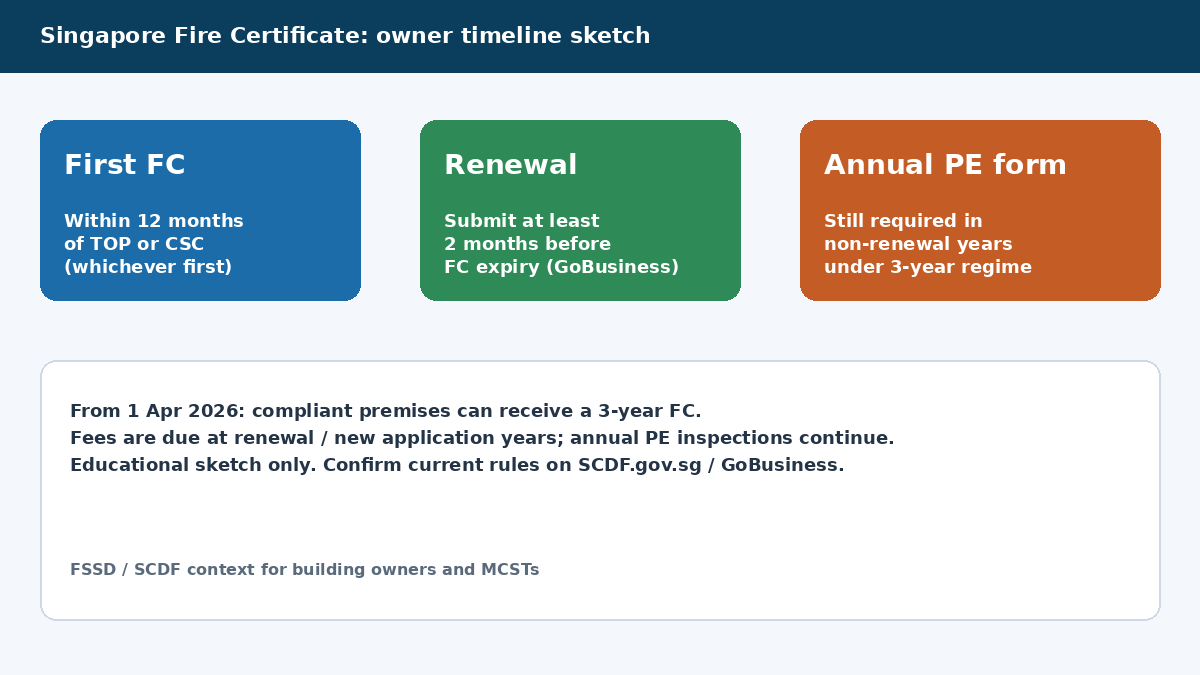
For a first Fire Certificate, SCDF requires submission within twelve months from the Certificate of Statutory Completion (CSC) or Temporary Occupation Permit (TOP), whichever comes first. First applications and renewals go through GoBusiness with building information and the endorsed FC form among the core attachments. The same licence flow, including payment options, is summarised on the GoBusiness Fire Certificate directory.
Renewals need calendar discipline: apply at least two months before the existing FC expires. Late or incomplete work can leave a designated building without a valid certificate. Lock PE inspection dates, contractor testing, owner or MCST endorsement, and FSM endorsement (where applicable) well before that two-month mark. Practitioners often describe fire certificate application and renewal steps as an operational sequence; keep any private guide beside SCDF instructions, not instead of them.
Why PE endorsement still matters every year
A longer certificate validity does not cancel annual engineering work. Official FAQ material states that annual Professional Engineer (PE) inspections remain mandatory because mechanical and electrical fire safety systems degrade over time. The PE certifies that declared systems have been maintained and tested against the Fire Code, the Act and its regulations, and relevant Singapore Standards. Where a Fire Safety Manager is required, the FSM’s certification sits alongside the PE’s on the FC form.
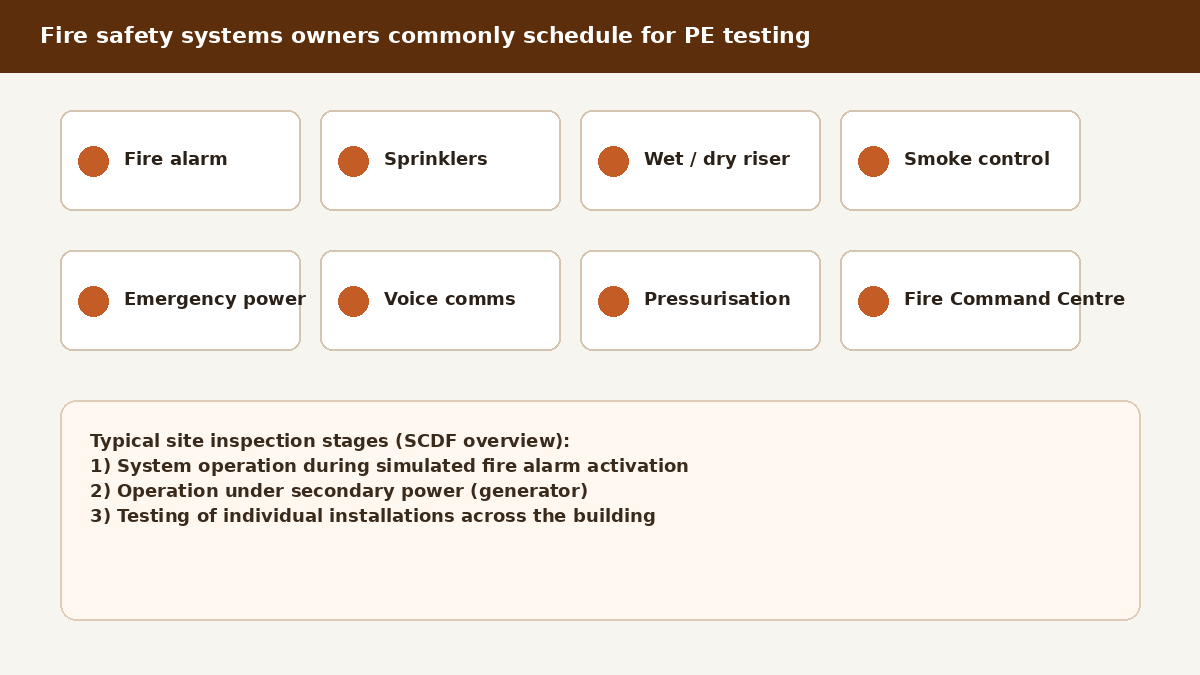
Scopes commonly include fire alarms, sprinklers, wet and dry risers, smoke control, pressurisation, emergency power, voice communication, lifts, and the Fire Command Centre. SCDF may select premises for audit. Deviation items need justification and rectification schedules without compromising protection. That is usually where professional engineer endorsement and contractor testing calendars meet building management.
Educational walkthrough of a fire safety certificate process. Use it as orientation only; Singapore submissions follow SCDF and GoBusiness steps.
The three-year FC regime from 1 April 2026
From 1 April 2026, SCDF extends FC validity from one year to three years for eligible buildings with a good compliance track record. Applications with a validity start date from that date onward are generally issued for 36 months unless otherwise stated. Fees are payable at new application or renewal years, not for annual FC form submissions in non-renewal years. Official tables list revised non-residential fees at $36 per storey; residential remains $11 per storey.
SCDF’s worked example: renew at least two months before a 31 May 2026 end date, receive a three-year FC from 1 June 2026 to 31 May 2029, submit annual FC forms by 31 May 2027 and 31 May 2028, then renew again (with PE certification) at least two months before 31 May 2029. Missing a non-renewal-year deadline can trigger revocation and enforcement. Detail sits in SCDF’s three-year Fire Certificate regime circular.
A practical pre-submission checklist
Before GoBusiness submit, smooth renewals share a boring checklist: confirm FCP reference and building particulars; book PE and contractor testing early; capture last testing dates for each declared system; obtain owner or MCST, PE, and FSM (if applicable) endorsements on the current form; choose card versus GIRO with enough runway (GIRO is slower and risky near expiry); and keep Corppass entitlements ready for the owner or authorised filer.
Day-to-day readiness still depends on the mechanical and electrical services that keep systems testable between certificate cycles. The certificate is the compliance milestone; the systems work is the continuous habit.
Planning question for your next owner or MCST meeting: Which FC date is least documented today (first application anniversary, two-month renewal lead time, or annual PE form), and who owns chasing PE slots before it arrives?