
Your Guide to Life, Business, and Adventure.

Your go-to platform for insights, inspiration, and practical tips on business, lifestyle, and the journey ahead. Stay informed, stay inspired, and keep moving forward.

Stories, Insights, and Inspiration for Everyday Life.

A space for ideas, experiences, and perspectives on life, business, and everything in between. Stay inspired, stay informed, and explore new possibilities.

  • Online Law Study in Singapore: Structure and Pathways

    Online Law Study in Singapore: Structure and Pathways

    How online and distance law study is usually structured

    Online and distance law study typically packages recorded lectures, reading lists, online tutorials, and timed assessments around a semester calendar. Students still need disciplined reading of statutes and cases; the screen does not shrink the volume of material. When exploring a law diploma e-learning pathway, clarify contact hours, assessment formats, and whether any on-campus intensives are required for Singapore-based or regional learners.

    Adult working at a white desk with an open laptop, books, and a mug
    Online and distance study still need a weekly timetable you will keep.

    SkillsFuture Singapore publishes public information on training and adult learning pathways. The Ministry of Law Singapore provides context on the legal sector environment. SkillsFuture Singapore (SSG) materials explain how private education institutions are regulated in Singapore (CPE functions now sit under SSG). Those named sources help applicants verify recognition questions before paying fees.

    Ask how library access, past papers, and tutor response times work in practice. Marketing pages rarely describe weekend load when you also hold a full-time job. Request a sample weekly timetable for a mid-semester week so you can stress-test it against your actual calendar.

    Accreditation and pathway questions for Singapore students

    Not every online law programme leads to the same professional pathway. Some diplomas are preparatory or foundational; others articulate into further degree study. Confirm whether the award is recognised for the next step you actually want: further academic study, paralegal work, or a regulated admission route that may require additional qualifications. Written confirmation from the institution beats verbal assurances at a fair booth.

    If your goal is practising as a lawyer, map the full chain of required qualifications separately from the marketing name of an e-learning diploma. Pathway diagrams on government or professional body sites are safer references than influencer summaries. Keep copies of any articulation letters in case staff change mid-programme.

    Business diplomas as a parallel foundation track

    Some adults compare law e-learning with a broader commercial foundation. A diploma in business emphasises management, marketing, and organisational skills rather than case method and statutory interpretation. That track can suit learners who want workplace mobility in commercial roles without committing to a legal pathway. Comparing the two is useful when you are still choosing a field, not when you already know you need law-specific reading skills.

    Look at assessment types: group projects and presentations common in business diplomas differ from problem questions and essay exams common in law modules. Match the assessment style to how you actually learn under time pressure. Ask whether group marks can be moderated if team members drop out mid-term.

    Digital transformation diplomas for working adults

    A digital transformation course overview focuses on technology change, process redesign, and digital tools in organisations. It shares little content with contract or tort modules, but it can complement careers in operations or product roles adjacent to legal teams. Working adults often choose it when their employer is modernising systems and they need structured vocabulary for that change.

    Ask whether projects can use your workplace as a case context, subject to confidentiality rules. Applied projects usually teach more than slide decks alone. Confirm evening class timings against your commute and caregiving schedule before you enrol. Check software licence costs that may sit outside tuition.

    Official SkillsFuture Singapore educational overview of lifelong learning pathways.

    Time management habits that keep distance study alive

    Block recurring calendar slots for reading before lectures, not only for live sessions. Keep a weekly page-count target for cases and textbooks. Form a small study group with clear agendas rather than open-ended chat. Tell family or housemates which evenings are protected. Review feedback on the first assessment early so later modules do not repeat the same citation mistakes. If work travel spikes, negotiate deadline extensions in writing before you fall behind silently. Revisit your programme choice after the first term with honest notes on workload versus career payoff, and adjust module load if your institution allows lighter terms.

    Overhead view of colleagues pointing at colourful charts on a table beside a tablet
    Business and digital diplomas reward teamwork habits as much as solo screen time.
  • Singapore Fire Certificate Guide for Building Owners

    If you own or occupy a designated building in Singapore, a Fire Certificate (FC) signals that fire safety systems have been inspected, tested, and kept in working order under the Fire Safety Act, administered by the Singapore Civil Defence Force (SCDF) and its Fire Safety & Shelter Department (FSSD). This piece is an informational briefing for building owners and management corporations. It is not legal advice; verify current forms, fees, and portals on official government pages before you submit.

    Which buildings need a Fire Certificate

    SCDF’s guidance under Section 35 of the Fire Safety Act 1993 covers categories such as larger public buildings, certain industrial buildings and foreign dormitories, hospitals, taller private residential blocks with specified active systems, engineered timber buildings with automatic systems, and some fully automated mechanised car parks. Thresholds turn on occupant load, floor or site area, and habitable height. HDB flats are generally carved out of the residential criteria on the official SCDF Fire Certificate page. Screen eligibility early with your Qualified Person and facilities team, not after the first FC clock has already started.

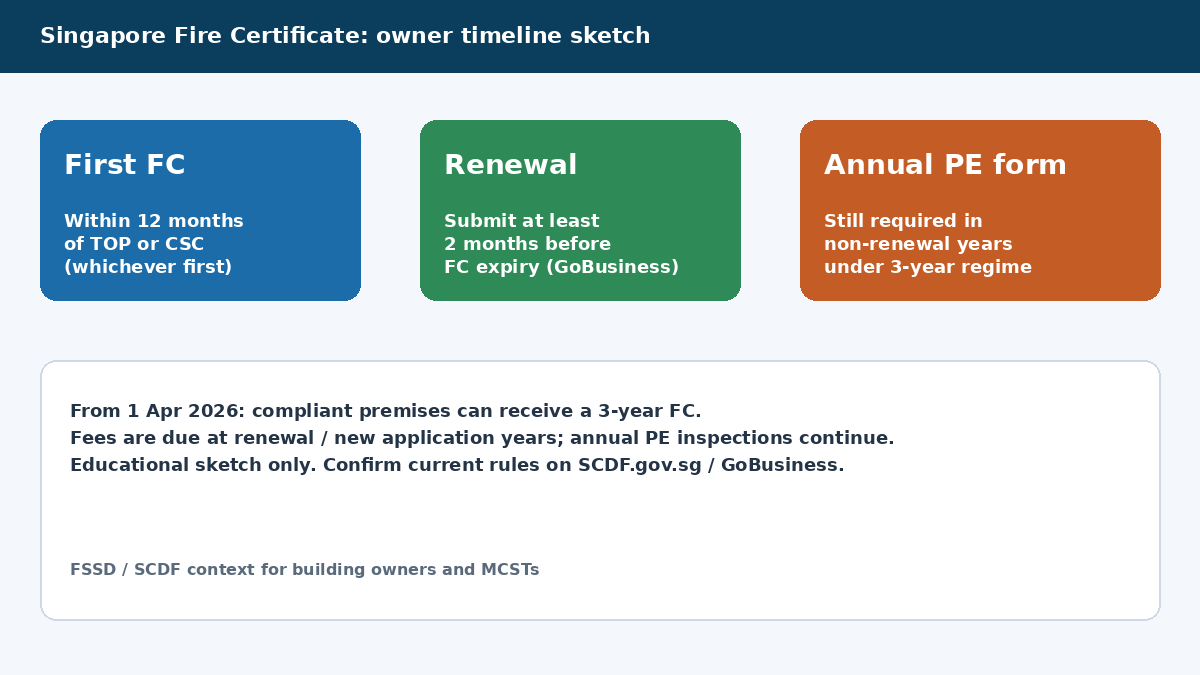
    Diagram of Singapore Fire Certificate timeline showing first application, renewal window, and annual PE form under the three-year regime
    Three clocks owners mix up: first FC after TOP/CSC, renewal before expiry, and annual PE certification during non-renewal years.

    Application and renewal timelines that trip owners up

    For a first Fire Certificate, SCDF requires submission within twelve months from the Certificate of Statutory Completion (CSC) or Temporary Occupation Permit (TOP), whichever comes first. First applications and renewals go through GoBusiness with building information and the endorsed FC form among the core attachments. The same licence flow, including payment options, is summarised on the GoBusiness Fire Certificate directory.

    Renewals need calendar discipline: apply at least two months before the existing FC expires. Late or incomplete work can leave a designated building without a valid certificate. Lock PE inspection dates, contractor testing, owner or MCST endorsement, and FSM endorsement (where applicable) well before that two-month mark. Practitioners often describe fire certificate application and renewal steps as an operational sequence; keep any private guide beside SCDF instructions, not instead of them.

    Why PE endorsement still matters every year

    A longer certificate validity does not cancel annual engineering work. Official FAQ material states that annual Professional Engineer (PE) inspections remain mandatory because mechanical and electrical fire safety systems degrade over time. The PE certifies that declared systems have been maintained and tested against the Fire Code, the Act and its regulations, and relevant Singapore Standards. Where a Fire Safety Manager is required, the FSM’s certification sits alongside the PE’s on the FC form.

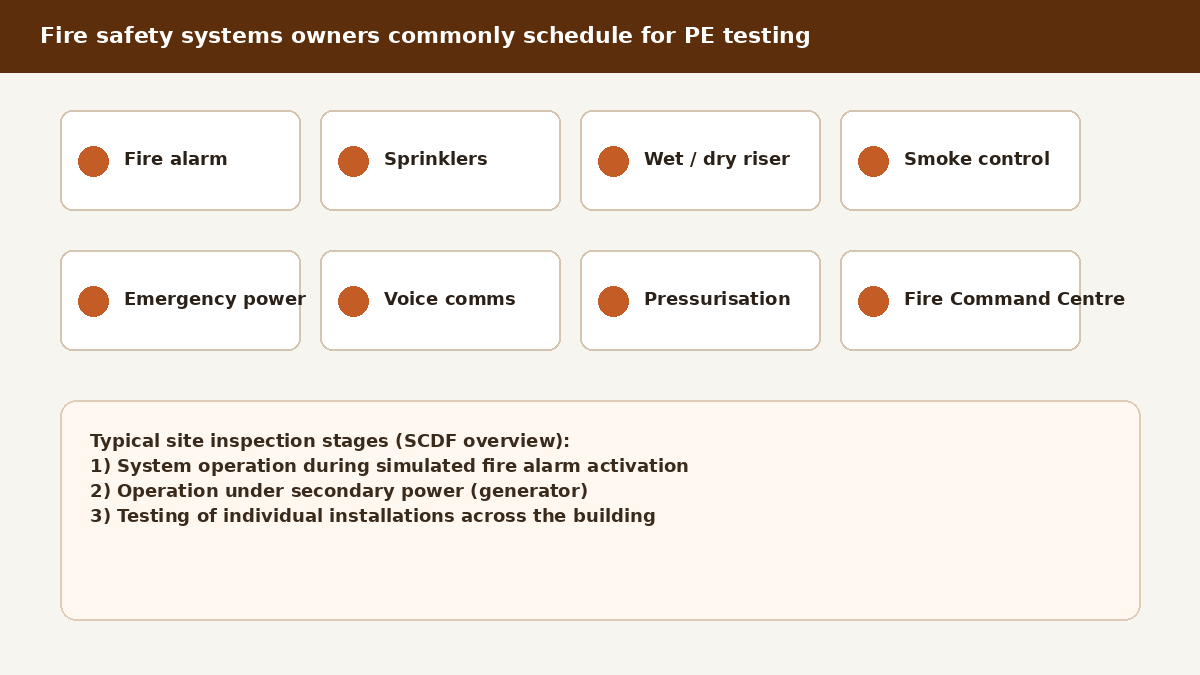
    Scopes commonly include fire alarms, sprinklers, wet and dry risers, smoke control, pressurisation, emergency power, voice communication, lifts, and the Fire Command Centre. SCDF may select premises for audit. Deviation items need justification and rectification schedules without compromising protection. That is usually where professional engineer endorsement and contractor testing calendars meet building management.

    Educational walkthrough of a fire safety certificate process. Use it as orientation only; Singapore submissions follow SCDF and GoBusiness steps.

    The three-year FC regime from 1 April 2026

    From 1 April 2026, SCDF extends FC validity from one year to three years for eligible buildings with a good compliance track record. Applications with a validity start date from that date onward are generally issued for 36 months unless otherwise stated. Fees are payable at new application or renewal years, not for annual FC form submissions in non-renewal years. Official tables list revised non-residential fees at $36 per storey; residential remains $11 per storey.

    SCDF’s worked example: renew at least two months before a 31 May 2026 end date, receive a three-year FC from 1 June 2026 to 31 May 2029, submit annual FC forms by 31 May 2027 and 31 May 2028, then renew again (with PE certification) at least two months before 31 May 2029. Missing a non-renewal-year deadline can trigger revocation and enforcement. Detail sits in SCDF’s three-year Fire Certificate regime circular.

    Educational grid of common building fire safety systems scheduled for Professional Engineer testing including alarms sprinklers risers and smoke control
    Systems owners usually put on the PE calendar: detection, suppression, smoke control, power, and command facilities.

    A practical pre-submission checklist

    Before GoBusiness submit, smooth renewals share a boring checklist: confirm FCP reference and building particulars; book PE and contractor testing early; capture last testing dates for each declared system; obtain owner or MCST, PE, and FSM (if applicable) endorsements on the current form; choose card versus GIRO with enough runway (GIRO is slower and risky near expiry); and keep Corppass entitlements ready for the owner or authorised filer.

    Day-to-day readiness still depends on the mechanical and electrical services that keep systems testable between certificate cycles. The certificate is the compliance milestone; the systems work is the continuous habit.

    Planning question for your next owner or MCST meeting: Which FC date is least documented today (first application anniversary, two-month renewal lead time, or annual PE form), and who owns chasing PE slots before it arrives?

  • Why Choose a UK MBA in Malaysia? A Blend of Quality and Affordability

    The pursuit of a Master of Business Administration (MBA) is a significant step for many professionals seeking to enhance their career prospects. While the United Kingdom is home to some of the most prestigious business schools, studying there often involves a significant financial investment. Many individuals aspire to become alumni of a UK business school, but for some, the cost can be prohibitive, forcing them to reconsider their dreams.

    Fortunately, the emergence of UK MBA programs in Malaysia offers a compelling alternative. These programs combine the esteemed quality of British education with greater affordability and convenience, making them an attractive option for aspiring business leaders. Learn more about MBA.

    The Value of a UK MBA in Malaysia: Global Recognition and Rigorous Curriculum

    A UK MBA carries significant weight in the global job market, known for its rigorous standards and innovative curriculum. Pursuing this qualification in Malaysia offers the same high-quality education at a fraction of the cost of studying directly in the United Kingdom. Many Malaysian business schools partner with top UK universities, ensuring their MBA courses adhere to international academic standards.

    Pursuing an MBA in Malaysia, even within the framework of a renowned UK university, provides access to this esteemed pedigree. Students can expect a rigorous curriculum, taught by experienced faculty with international expertise, covering a wide range of business disciplines, from finance and marketing to operations management and strategic leadership. Learn more about Alliance Manchester courses.

    Affordability and Accessibility: Making Higher Education More Attainable

    One of the most compelling reasons to pursue a UK MBA in Malaysia is its affordability. Tuition fees for UK MBA programs overseas can be prohibitively high, but Malaysian business schools provide the same degree at significantly lower costs. Additionally, Malaysia’s relatively low cost of living makes it a practical choice for both local and international students. By studying locally, students save on travel and accommodation expenses while earning a prestigious UK qualification.

    Since tuition fees and living expenses are generally lower within Malaysia, the pursuit of higher education is more attainable for a wider range of aspiring professionals, including those with financial constraints. Moreover, studying locally minimises the disruption to personal and professional commitments, allowing working professionals to pursue their MBA while maintaining their careers.

    Flexibility and Specialisation: Catering to Diverse Learning Needs

    Malaysian business schools offer a variety of UK MBA programs to suit diverse professional needs. From part-time MBA options tailored for working professionals to specialised programs like EMBA (Executive MBA), the flexibility of these courses ensures accessibility for all. Whether you are an aspiring leader or a seasoned professional looking to enhance your career, there is a program for you.

    These programs cater to diverse learning styles and professional needs. Full-time programs offer an immersive learning experience for those who can dedicate their full attention to their studies. Part-time MBA options provide greater flexibility for working professionals, allowing them to balance their academic pursuits with their career responsibilities. Executive MBA (EMBA) programs are specifically designed for experienced executives, offering a rigorous and intensive learning experience focused on developing advanced leadership and strategic management skills.

    For working professionals, pursuing further education often requires balancing career, family, and academic commitments. Malaysian business schools excel in offering part-time MBA and EMBA programs that provide the flexibility needed to maintain a work-life-study balance.

    Beyond the General MBA: Specialised Program for Career Growth

    In addition to the Master of Business Administration, Malaysian business schools also cater to niche fields. Programs like Masters in Finance, Masters in Education Management, and Masters in Educational Leadership are becoming increasingly popular among professionals aiming for specialisation in their careers.

    1. Masters in Finance: Ideal for those pursuing expertise in financial strategies, investment management, and corporate finance.
    2. Masters in Education Management: Tailored for professionals aiming to lead educational institutions with effective organizational and managerial skills.
    3. Masters in Educational Leadership: Designed for educators aspiring to take on leadership roles within schools, colleges, or policy-making bodies.

    Conclusion: A Wise Investment in Your Future

    Choosing a UK MBA in Malaysia means enjoying the best of both worlds—a globally respected qualification and a supportive, culturally rich learning environment. With top-notch facilities, experienced faculty, and a curriculum aligned with international standards, Malaysian business schools are a compelling choice for ambitious professionals.

    Whether you’re interested in a traditional MBA course, a part-time MBA, or specialised programs like Masters in Finance or Masters in Educational Leadership, Malaysian business schools have something to offer every professional. Embrace the opportunity to advance your career with a globally recognized qualification, all while enjoying the vibrant and diverse educational landscape that Malaysia has to offer. Learn more about educational leadership.

Living, Learning, and Growing Every Day.

Life is a journey of constant growth and discovery. Here, we share insights, inspiration, and stories that help you navigate challenges, embrace opportunities, and make each day more meaningful. Whether it’s personal growth, career insights, or everyday wisdom, we’re here to explore it all with you.